Anti-Waste Watchdog Drops $2.3 Million on Office Makeover, Explains How Artisanal Signage Will Save Taxpayers Billions
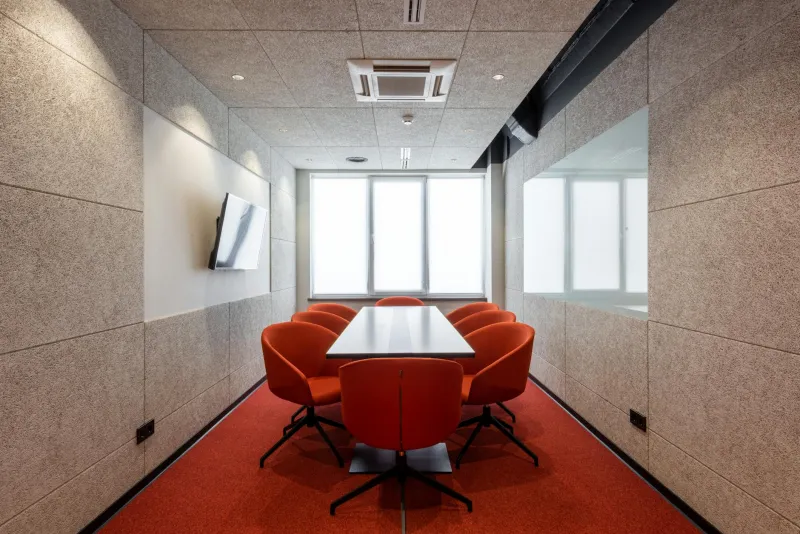
Committee Discovers Waste Elimination Requires Premium Workspace
The Senate Subcommittee on Government Waste has successfully completed a $2.3 million headquarters renovation, transforming their cramped federal building offices into what Chairman Senator Marcus Fieldstone describes as "a beacon of fiscal responsibility in an ocean of government excess."
The renovation, which took eighteen months and required approval from seven different oversight committees, features hand-selected Brazilian walnut paneling, ergonomic furniture crafted by Amish artisans, and what officials are calling "the crown jewel" of the project: custom hand-lettered signage reminding staff that "Every Dollar Counts" and "Waste Not, Want Not."
"You have to understand the psychology of waste elimination," explained Subcommittee Communications Director Jennifer Hartwell, gesturing toward a $47,000 reclaimed wood conference table. "Our staff are making life-or-death decisions about taxpayer money every single day. They need an environment that reflects the gravity of that responsibility."
Juice Bar Deemed Essential Infrastructure
Perhaps the most controversial element of the renovation is the installation of a full-service juice and smoothie bar, complete with imported Italian espresso machine and a dedicated staff nutritionist. The $180,000 wellness station was justified in internal documents as "critical infrastructure for maintaining the mental acuity necessary for identifying wasteful spending patterns."
"A well-nourished committee member is a fiscally responsible committee member," noted Deputy Director of Operations Sarah Chen, while preparing what she described as a "productivity-enhancing kale and goji berry blend." Chen emphasized that all smoothie ingredients are sourced from certified organic farms within a 200-mile radius, adding only $23,000 annually to operational costs.
The subcommittee's resident efficiency expert, Dr. Ronald Pemberton, produced a 400-page analysis demonstrating how the juice bar will ultimately save taxpayers money. "Our preliminary models suggest that properly hydrated staff members identify wasteful spending 12% more efficiently," Pemberton explained, citing data from what he described as "extensive research into the correlation between antioxidant intake and bureaucratic performance."
Motivational Messaging Costs More Than Most Houses
The renovation's most striking feature remains the custom signage, created by what project documents identify as "a renowned calligrapher specializing in governmental inspiration." The artist, who commands $2,800 per letter, has adorned the office with phrases including "Stewards of the Public Trust," "Excellence Through Accountability," and "Your Tax Dollars at Work."
"People don't realize how demoralizing it can be to spend all day looking at wasteful government spending," reflected Subcommittee Researcher Timothy Walsh, seated beneath a $34,000 hand-painted mural depicting the Boston Tea Party. "These visual reminders help us stay focused on our mission of protecting the American taxpayer from exactly this kind of frivolous expenditure."
The signage project required three separate consultations with feng shui specialists to ensure optimal placement for "maximum motivational impact," according to internal memos obtained through Freedom of Information Act requests.
Cost-Benefit Analysis Reveals Savings Through Spending
Subcommittee officials have produced detailed projections showing how the renovation will pay for itself within 847 years through improved staff efficiency. The analysis, prepared by the consulting firm Synergy Solutions at a cost of $89,000, concludes that "strategic investment in workplace optimization creates exponential returns in waste identification capabilities."
"You have to spend money to save money," Chairman Fieldstone observed during the ribbon-cutting ceremony, which featured a $12,000 catered lunch from a farm-to-table restaurant specializing in "ethically sourced government dining experiences." "This renovation positions us to identify and eliminate the kind of wasteful spending that has plagued Washington for decades."
The ceremony also included remarks from Interior Design Coordinator Michelle Torres, who explained how the office's new "open concept collaborative workspace" will foster the kind of creative thinking necessary for "reimagining fiscal responsibility in the 21st century."
Next Meeting Postponed Due to Catering Crisis
The subcommittee's next scheduled meeting to address wasteful spending throughout the federal government has been indefinitely postponed following what officials describe as "an unfortunate misunderstanding" with their preferred catering company. Sources close to the matter indicate the dispute centers on whether the committee's standard $3,200-per-meeting refreshment budget should include imported French pastries or merely domestic artisanal baked goods.
"We refuse to compromise on the quality of our working lunches," stated Administrative Coordinator David Park. "How can we make sound decisions about government waste while consuming substandard refreshments? It sends entirely the wrong message about our commitment to excellence."
The subcommittee has commissioned a $45,000 study from the Institute for Governmental Dining Standards to resolve the catering crisis and establish "best practices for taxpayer-funded committee nutrition." Results are expected sometime next fiscal year, pending approval from the Senate Subcommittee on Subcommittee Oversight.