Historic Cross-Party Committee Formed to Solve the Mystery of Why Cross-Party Committees Solve Nothing
WASHINGTON — In a development that political scientists are calling either "deeply ironic" or "perfectly on brand," Congress has formally established the Joint Bipartisan Commission on the Persistent Failure of Bipartisan Commissions, a sixteen-member cross-party body charged with investigating the peculiar Washington phenomenon in which broad political agreement produces absolutely no tangible results.
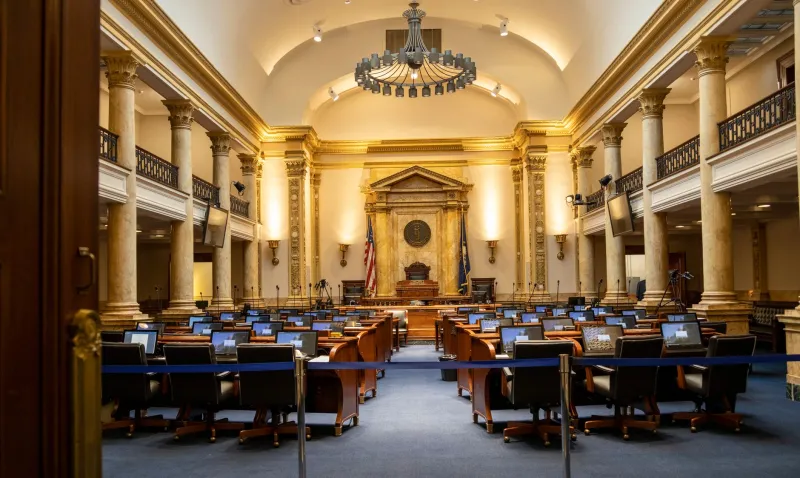
The commission, which enjoys enthusiastic support from both parties and is therefore, experts note, almost certainly doomed, held its inaugural meeting on Tuesday in a Senate conference room that had been booked, double-booked, and then re-booked under a different name to resolve the double-booking.
A Promising Start, Technically
The session opened at 10 a.m. with what Commission Co-Chair Senator Dale Whitmore (R-OH) described as "a tremendous amount of energy in the room." This energy was channeled immediately into a procedural dispute over whether the commission's founding document should use the spelling "bipartisan" or "bi-partisan," a question that consumed the first two hours and forty minutes of the meeting and was ultimately resolved by a 9-7 vote in favor of no hyphen, with three members abstaining on the grounds that they had not been informed there would be a vote.
"We made real progress today," Senator Whitmore told reporters afterward, straightening his lapel pin, which features a handshake between a donkey and an elephant that someone in his office ordered from a novelty website in 2019. "The fact that we got to nine-seven on anything is, frankly, historic."
Asked what the commission had determined about the underlying causes of bipartisan failure, Senator Whitmore said he was "very optimistic" and that they planned to "get into the substance" at one of the seventeen follow-up meetings now scheduled through the end of the fiscal year.
The Agenda, Reconstructed
A copy of Tuesday's meeting agenda, obtained by this publication, lists eleven items. According to attendees, the group reached item two before lunch and did not return to the conference room until 2:15 p.m., at which point three members had left for flights, one had a constituent call, and the remaining twelve spent forty minutes locating a working projector.
Item three on the agenda — "Define the problem we are studying" — was tabled until the February 14th session, which four members noted conflicts with Valentine's Day recess, a scheduling conflict that will be addressed at a yet-to-be-scheduled pre-session.
The commission's Democratic Co-Chair, Representative Anita Flores (D-CA), expressed confidence that the group's diverse makeup was itself evidence of success. "The fact that we're in the same room," she said, "is already more than most people expected." She declined to comment on whether anyone had yet agreed on what the room was for.
Expert Testimony Nobody Requested
The Brookings-Adjacent Institute for Legislative Functionality, a think tank that has published forty-seven reports on congressional gridlock since 2018, released a statement welcoming the commission's formation and noting that, based on their research, committees formed to study committee dysfunction have a 94% rate of becoming examples of the very dysfunction they were created to study.
"It's a rich irony," said the institute's Senior Fellow for Irony Studies, Dr. Carla Mendes, in a phone interview. "But we remain hopeful. We've been remaining hopeful for eleven years. It's more or less our entire business model."
Dr. Mendes added that her institute had submitted a formal request to present findings to the commission, and had been told to contact the office of the deputy scheduling coordinator, who is currently on a detail to another agency and expected back in the spring.
Seventeen Meetings, Zero Deliverables: A Roadmap
The commission's published schedule of follow-up sessions is, by any measure, ambitious. Meetings are planned for every third Thursday through November, with two emergency sessions built in for what the scheduling document calls "unforeseen moments of potential agreement that may require immediate deferral."
The final deliverable — a report on why bipartisan efforts fail — is due fourteen months from now, which several commission members noted is conveniently after the midterm election cycle, meaning its findings will arrive at a moment when a third of the Senate has either just won or just lost and will be in no mood to act on anything.
"The timeline is realistic," Senator Whitmore said. "We didn't want to rush something this important."
Asked whether the commission had considered the possibility that producing a fourteen-month report on bipartisan failure while failing to accomplish anything bipartisan might undermine the report's credibility, he said that was "a great question" and suggested it be submitted in writing to the commission's feedback portal, which will be live "once IT finishes setting it up."
Nothing Will Change, Sources Confirm
Political analysts following the commission's formation say the body represents a genuinely novel contribution to Washington's long tradition of substituting the study of problems for their solution.
"What's impressive here," said one congressional observer who requested anonymity because they still have meetings with these people, "is the recursive quality of it. They've managed to create a bipartisan failure about bipartisan failure in real time. That's almost elegant."
The commission's next meeting is scheduled for the third Thursday of next month, assuming the conference room is available, the projector has been located, and all sixteen members can agree on what time zone to use for the calendar invite, a question that, as of press time, remains formally unresolved.