Premier Influence Facilitation Group Publishes 200-Page Report Proving It Definitely Doesn't Influence Anything
Transparency Through Creative Terminology
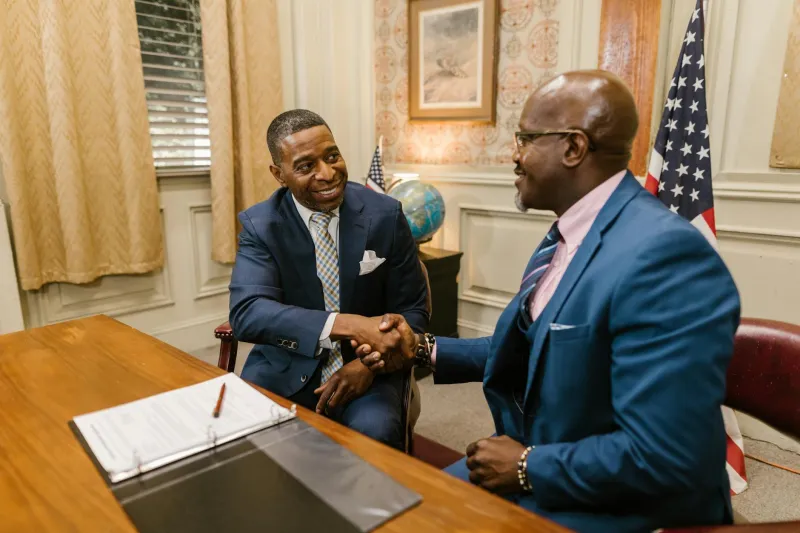
Strategic Solutions Alliance (SSA), a prominent Washington-based "stakeholder engagement facilitation organization," has published its most comprehensive annual report yet, a 247-page document titled "Building Bridges: Our Commitment to Democratic Dialogue Enhancement." The report, printed on sustainably sourced paper and featuring seventeen stock photos of diverse professionals shaking hands, meticulously documents the firm's complete lack of influence over any governmental processes whatsoever.
"We are proud to serve as a neutral conduit for information exchange between concerned citizens and their elected representatives," explained SSA Managing Partner Victoria Ashworth-Sterling during the report's launch event at the Willard InterContinental Hotel. "Our role is purely educational—we simply help policymakers understand complex issues by providing them with carefully researched talking points, draft legislation, and occasional Caribbean fact-finding missions."
 Photo: Victoria Ashworth-Sterling, via naomivictorialoves.com
 Photo: Willard InterContinental Hotel, via liveandletsfly.com
The Evolution of Civic Engagement
SSA's journey from straightforward influence-peddling operation to "thought leadership ecosystem" represents a masterclass in organizational rebranding. Founded in 1987 as "Ashworth & Associates Government Relations," the firm originally specialized in what former employees describe as "telling senators what their corporate clients wanted them to do."
The transformation began in 2003 with the adoption of the "Strategic Solutions" name, followed by the 2008 establishment of their "Democracy Enhancement Division," and culminating in 2015 with the creation of their "Civic Dialogue Innovation Lab." Each rebrand coincided with increased scrutiny of lobbying activities, a timing that SSA describes as "purely coincidental."
"We recognized that traditional advocacy methods were becoming outdated," noted Senior Partner Marcus Chen-Pemberton. "Modern democracy requires more sophisticated approaches to citizen engagement—approaches that definitely don't constitute lobbying under any reasonable interpretation of federal regulations."
Solutions-Oriented Problem Solving
The annual report showcases SSA's commitment to "solutions-based stakeholder optimization," a proprietary methodology that the firm claims has revolutionized how concerned citizens communicate with government officials. The approach involves what SSA terms "strategic information architecture," which appears to consist primarily of hosting expensive dinners where corporate executives happen to sit next to key legislators.
"We're not lobbyists," emphasized Director of Public Engagement Jennifer Walsh-Morrison. "We're facilitators of democratic discourse. When our pharmaceutical industry clients want to discuss healthcare policy with FDA officials, we simply provide a neutral venue—usually a nice restaurant—where meaningful dialogue can occur organically."
The report includes detailed case studies of SSA's "successful stakeholder alignments," including their work helping "concerned energy sector citizens" communicate their perspectives on environmental regulations to EPA administrators. Purely by coincidence, these concerned citizens all happened to be senior executives at major oil companies.
Thought Leadership Excellence
SSA's annual "Policy Innovation Symposium" has become a cornerstone of Washington's intellectual landscape, bringing together "diverse voices" to discuss pressing national issues. Last year's symposium on telecommunications policy featured a remarkable consensus among attendees—all of whom represented major telecommunications companies—that current regulations were unnecessarily burdensome.
"We pride ourselves on facilitating authentic dialogue," explained Dr. Patricia Hendricks, SSA's Director of Intellectual Capital Development. "When twelve different telecom executives independently reach the same conclusions about policy reform, that's not coordination—that's the marketplace of ideas working exactly as intended."
The firm's research division has produced numerous white papers on topics ranging from "Optimizing Regulatory Frameworks for Innovation Enhancement" to "Stakeholder-Centered Approaches to Compliance Streamlining." These documents, which SSA distributes free of charge to interested policymakers, consistently conclude that whatever SSA's clients want is also what's best for America.
Regulatory Relationship Success Stories
Perhaps SSA's greatest achievement has been what they term "alumni engagement optimization." The report proudly notes that former SSA partners now serve in senior positions at the Department of Energy, the Federal Communications Commission, and the Securities and Exchange Commission—the very agencies their former colleagues continue to "educate" about industry perspectives.
 Photo: Federal Communications Commission, via vignette.wikia.nocookie.net
"It's wonderful to see our former team members bringing their expertise to public service," beamed Ashworth-Sterling. "Their deep understanding of stakeholder concerns obviously has nothing to do with their previous employment here. Government service attracts the best and brightest from all sectors."
The report includes testimonials from these former employees, who unanimously praise SSA's commitment to "civic engagement excellence" while noting that their current regulatory positions are "completely unrelated" to their previous advocacy work.
Measurable Democratic Enhancement
SSA's impact metrics are impressive: over the past decade, they have facilitated 1,247 "educational briefings" between clients and government officials, organized 89 "policy dialogue sessions" in resort locations, and distributed 12,000 "informational documents" to congressional staff members. The report notes with satisfaction that legislation aligned with client interests has passed at a rate of 73%, though SSA attributes this success to "the compelling nature of fact-based policy arguments" rather than any form of influence.
"Numbers don't lie," observed Chen-Pemberton. "When good policy ideas are properly communicated through appropriate channels, democracy works. It's really that simple."
The firm's fee structure, detailed in an appendix, includes charges for "stakeholder education services" ($50,000 monthly retainers), "policy research and analysis" ($25,000 per white paper), and "democratic dialogue facilitation" ($15,000 per dinner). SSA emphasizes that these fees reflect the considerable expertise required for effective civic engagement, not any form of influence purchasing.
Looking Forward: Innovation in Democratic Participation
As SSA enters its fourth decade of "civic engagement facilitation," the firm remains committed to expanding democratic participation through innovative stakeholder alignment methodologies. Plans for 2024 include launching a "Citizen Advocacy Academy" to train corporate executives in effective grassroots communication techniques and establishing a "Democracy Innovation Fellowship" program that will definitely not involve former government officials receiving lucrative consulting contracts.
"The future of American democracy depends on informed dialogue between citizens and their representatives," concluded Ashworth-Sterling. "We're proud to facilitate that dialogue, one expensive dinner at a time. And if that dialogue occasionally results in favorable regulatory outcomes for our clients, well, that's just democracy working as the Founders intended."