Senate Panel Dedicated to Eliminating Inefficiency Spends Nearly Half a Million Studying Its Own Purpose
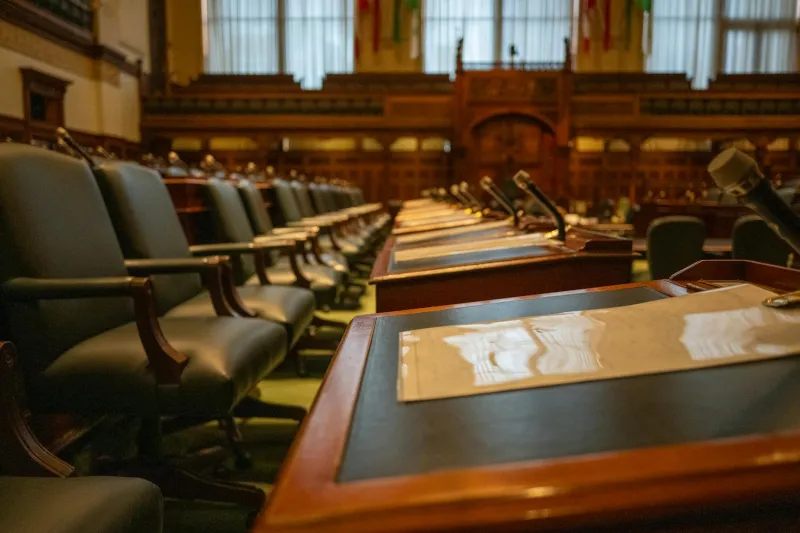
A Meta-Bureaucratic Marvel
In what observers are calling either peak governmental self-awareness or the ultimate act of institutional navel-gazing, the Senate Subcommittee on Streamlining Government Operations has awarded a $400,000 contract to McKenzie & Associates Strategic Consulting to conduct a "comprehensive functionality assessment" of its own existence.
The subcommittee, originally established in 1987 with the noble goal of reducing redundant federal agencies, has apparently reached such heights of introspection that it now questions whether questioning things is itself worth questioning.
"We felt it was prudent to ensure our oversight activities align with contemporary efficiency paradigms," explained Subcommittee Chair Senator Margaret Whitfield (R-TX) during a 47-minute press conference that could have been a three-sentence email. "This assessment will provide actionable insights into our impact metrics and stakeholder value propositions."
The Irony Deepens
The $400,000 price tag represents a curious milestone, as it exceeds the subcommittee's annual operating budget of $279,000 by a comfortable margin. When pressed on this apparent mathematical inconsistency, Whitfield's office issued a clarifying statement explaining that the review costs would be "absorbed through creative budgetary reallocations and synergistic cross-departmental funding optimization."
Translation: they're borrowing money from other committees to pay someone to tell them if they should exist.
The subcommittee's ranking member, Senator David Chen (D-CA), expressed cautious optimism about the review process. "For too long, we've been making decisions about our relevance based on gut feelings and constituent feedback," Chen noted. "It's time we had hard data about whether the data we collect about collecting data serves the American people."
A Track Record of Excellence
Since its inception 37 years ago, the Subcommittee on Streamlining Government Operations has produced an impressive portfolio of recommendations. Their greatest hits include eleven separate reports advocating for the creation of additional oversight bodies, a 400-page white paper on the optimal font size for federal forms, and a landmark 2019 study concluding that "efficiency is generally preferable to inefficiency, pending further analysis."
The subcommittee's most recent accomplishment was a six-month investigation into why federal agencies take so long to respond to information requests. The investigation concluded that agencies take a long time to respond to information requests, a finding that required 847 pages to fully articulate.
"We've consistently delivered actionable recommendations," insisted Subcommittee Research Director Dr. Patricia Holloway, whose business card lists her title as "Senior Principal Deputy Associate Director of Operational Excellence Initiatives." "The fact that none of these recommendations have been implemented doesn't diminish their theoretical value."
Expert Analysis
Government efficiency expert Dr. Richard Blankenship of the Institute for Watching Government Watch Things called the self-assessment "a natural evolution of bureaucratic self-preservation instincts."
"What we're witnessing is bureaucracy achieving consciousness," Blankenship explained. "Like a digital organism questioning its own code, this subcommittee has reached the philosophical endpoint of governmental introspection. It's either deeply profound or completely ridiculous. Possibly both."
Meanwhile, Dr. Sarah Martinez from the Center for Studying Studies noted that commissioning external reviews of internal review processes represents "peak meta-governance." She added, "I wouldn't be surprised if they next commission a study to evaluate the effectiveness of the study evaluating their effectiveness."
The Assessment Process
McKenzie & Associates promises to deliver their findings within 18 months, pending approval from their own internal review board, which must first be reviewed by their quality assurance team. The consulting firm's proposal includes 47 distinct phases of analysis, each requiring separate approval from different subcommittee working groups.
"We're committed to providing the most thorough assessment possible," explained McKenzie & Associates Senior Partner James McKenzie III. "Our preliminary assessment of our assessment methodology suggests we'll need to assess our assessment approach before we can begin the actual assessment."
The firm's track record includes previous government contracts such as a $2.3 million study on why federal studies cost so much, and a $890,000 analysis of whether analysis is cost-effective.
Looking Forward, Backwards, and Sideways
As the assessment moves forward, the subcommittee continues its regular operations, which primarily consist of scheduling meetings to discuss when to schedule future meetings. Their next major initiative involves a comprehensive review of their meeting scheduling protocols, estimated to cost $127,000 and require input from at least fourteen additional federal agencies.
"Regardless of what this assessment concludes, we remain committed to our mission of determining whether our mission is necessary," Senator Whitfield concluded. "That's what good governance looks like in the 21st century."
The McKenzie & Associates assessment is expected to conclude sometime in late 2025, assuming Congress approves funding for a supplemental review of the review timeline. Early indicators suggest the final recommendation will be the formation of a permanent oversight committee to monitor the subcommittee's ongoing relevance, staffed by twelve full-time employees and supported by a $3.2 million annual budget.
In related news, the House Committee on Reducing Committee Redundancy has announced plans to study the Senate's approach to studying itself, pending approval from the Joint Committee on Inter-Chamber Committee Coordination.