Senate Subcommittee on Government Transparency Holds Seventh Consecutive Closed-Door Meeting to Discuss Openness
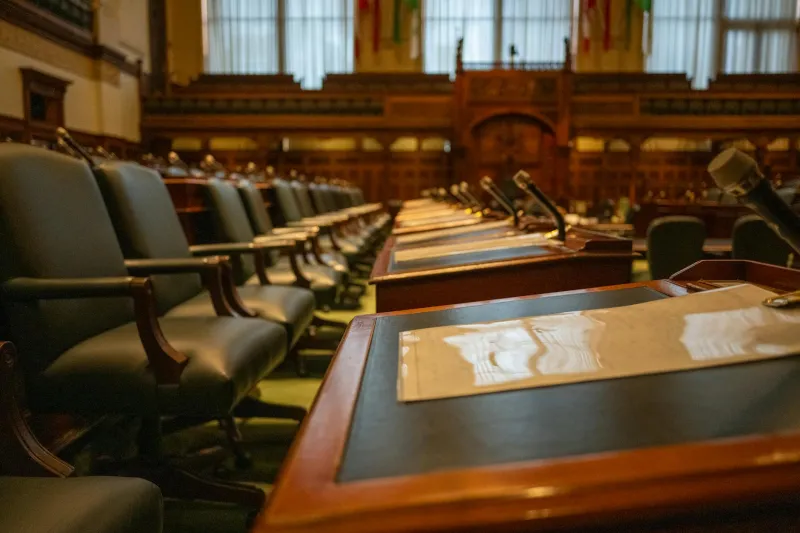
Committee Discovers Transparency Works Better in Dark
The Senate Subcommittee on Government Transparency concluded its seventh consecutive closed-door session yesterday, emerging to announce that discussions about government openness are proceeding "exceptionally well" in complete secrecy.
Chairman Senator Patricia Holloway (R-TX) explained to bewildered reporters that the committee's shift from public hearings to private deliberations represents a "strategic pivot toward authentic transparency."
"You simply cannot have honest conversations about honesty when everyone's listening," Holloway declared, standing behind a podium marked 'OPEN GOVERNMENT INITIATIVE.' "True transparency requires a safe space where we can candidly discuss how to be more candid with the American people."
Ranking Member Calls Secrecy 'Refreshingly Honest'
Ranking minority member Senator Marcus Chen (D-CA) praised the committee's approach as "refreshingly honest about our need to be dishonest temporarily."
"We're being transparent about our lack of transparency," Chen noted. "That's more transparent than most committees, which pretend to be transparent while actually being transparent, which is obviously less transparent than being transparently non-transparent."
Chen added that the committee expects to release a comprehensive public report on their private discussions "once we finish our confidential review of what we're allowed to tell you about our confidential review."
Expert Panel Weighs In Through Spokesperson
Dr. Rebecca Martinez, Director of the Washington Institute for Government Accountability, offered measured support for the committee's methodology through a carefully worded statement delivered by her assistant.
"The subcommittee's commitment to discussing openness in a completely closed environment demonstrates the kind of innovative thinking that Washington desperately needs," the statement read. "Sometimes you have to hide transparency in order to find it."
Martinez herself was unavailable for comment, as she was attending a private conference on public engagement.
Timeline of Increasing Opacity
The subcommittee's journey toward complete secrecy began fourteen months ago when Chairman Holloway announced that public hearings were creating "too much public interest" in government transparency.
"We were getting distracted by citizens asking questions about accountability," Holloway explained at the time. "How can we focus on serving the public when the public keeps interrupting?"
The first closed session, originally scheduled for two hours, lasted eight hours as committee members discovered they could speak more freely without constituents present. Subsequent meetings grew longer and more frequent, with the most recent session extending across three days and requiring catered meals.
"We accomplished more in those three days than we had in the previous six months of public hearings," noted committee member Senator James Rutledge (R-FL). "It turns out transparency is much clearer when nobody can see it."
Innovative Approach to Public Engagement
The committee has developed what Holloway calls "reverse accountability" – a system where government officials inform the public by not informing them, thereby preserving the purity of the information.
"Every time we explain what we're doing, it changes what we're doing," Holloway said. "By not explaining anything, we maintain the integrity of our original intentions, whatever those were."
The committee has also pioneered "preemptive transparency," where they announce their commitment to eventual openness before determining what they might eventually be open about.
Stakeholder Reactions Pour In
Government watchdog organizations have responded with what can only be described as confused appreciation.
"We're cautiously optimistic about their pessimistic caution," said Tom Brennan, Executive Director of Citizens for Open Government. "At least they're being honest about being dishonest, which is more honesty than we usually get about dishonesty."
The American Transparency Coalition issued a statement praising the committee's "bold commitment to eventually telling us what they're boldly committed to."
Looking Forward to Looking Backward
Chairman Holloway announced that the committee will continue meeting in private until they've resolved the question of whether they should meet in public.
"We're making excellent progress toward determining what progress looks like," Holloway said. "Once we've privately agreed on how to publicly disagree, we'll be ready to openly discuss why we were closed."
The committee's next closed session is scheduled for next Tuesday, assuming they can agree in private about whether to publicly announce the private meeting they're privately planning to have about public announcements.
Senator Chen concluded yesterday's non-briefing with characteristic clarity: "The American people deserve to know that we're working hard to decide what they deserve to know about our hard work."
Reporters were then escorted from the building by security guards who declined to identify themselves, citing transparency concerns.