Administration Launches Sweeping Initiative to Look Extremely Busy While Doing Functionally Nothing
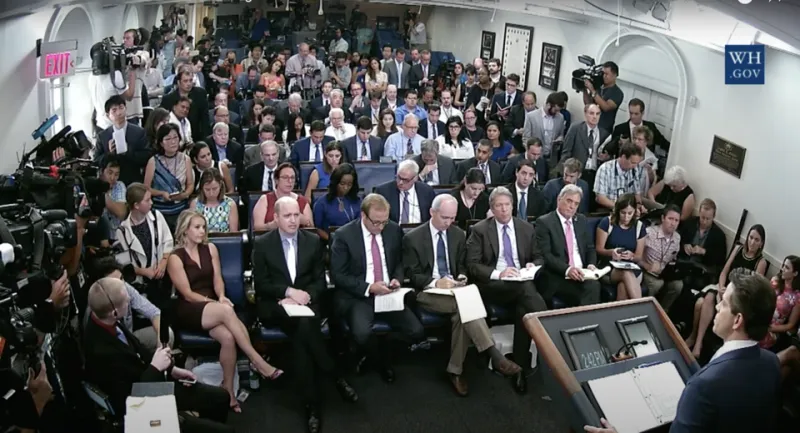
Photo: White House Press Office, Public domain, via Wikimedia Commons
The White House announced Monday what press secretary Dana Morello called 'the most comprehensive, action-oriented, forward-leaning response this administration has ever assembled,' in reference to the thing that Americans are currently very angry about, which has been in the news for several weeks and which the administration had previously responded to by saying it was 'monitoring the situation closely' and 'taking all options seriously,' both of which turned out to mean nothing.
 Photo: Dana Morello, via www.messinaora.it
 Photo: The White House, via www.thenation.com
The new initiative — formally titled the American Solutions Forward Framework for Action and Dialogue, or ASFFAD, which Morello acknowledged 'still needs some work acronym-wise' — consists of four distinct components, none of which constitute a policy, three of which do not have start dates, and one of which is a website that does not yet exist but is 'in active development,' which a senior official later clarified means someone has purchased the domain name.
'The President is absolutely committed to doing something about this,' Morello told reporters. 'And today, we're doing something. Specifically, we're doing this. Which is something.'
The Four Pillars of Apparent Action
The ASFFAD rests on four pillars, each of which was described in the official announcement using a different action verb to create the impression of momentum.
Pillar One: The Task Force. A bipartisan task force will be convened to study the issue and deliver recommendations within twelve to eighteen months, a timeline that places its conclusions comfortably after the midterm elections and, depending on how things go, possibly after the next presidential election as well. The task force will be co-chaired by two former senators whose primary qualification, officials confirmed, is that they are universally regarded as 'people no one has strong feelings about.' Membership will include representatives from 'all relevant stakeholder communities,' a phrase that in practice means the same twelve organizations that are represented on every task force.
Pillar Two: The Listening Tour. Three Cabinet secretaries will travel to six cities over the next four months to 'hear directly from American families about how this issue affects their lives.' The cities were selected, according to an internal document obtained by Officially Absurd, based on a combination of swing-state status and the availability of adequately sized hotel conference rooms with good AV setups. Members of the public wishing to attend must pre-register, submit a brief written statement, and be selected by lottery, after which they will have ninety seconds to speak to a Cabinet secretary who will nod attentively and write nothing down.
Pillar Three: The Framework for Future Conversations. This is, by any objective measure, the most innovative component of the initiative. Rather than establishing policy, the administration has established a 'structured dialogue architecture' that will 'create the conditions for productive future conversations between relevant parties about potential pathways toward action.' When asked what this meant, a senior official said: 'It means we're building the table. At which future conversations will happen. About what to put on the table.' A follow-up question about whether the table currently existed was met with a statement about the administration's commitment to infrastructure.
Pillar Four: The Website. The website will 'serve as a centralized hub for information, resources, and community engagement' on the issue. It will feature a FAQ section, a map of the listening tour locations, and a form through which members of the public can submit their concerns, which will be reviewed by a contractor and summarized in a quarterly report that will be sent to the task force. The website will be operational 'within the coming weeks,' which officials define as 'a period of time measured in weeks.'
What Focus Groups Think, and Why That's All That Matters
Political strategist Carla Osei, who has consulted for both parties and describes her job as 'telling people what voters think so they can ignore it more efficiently,' said the ASFFAD represents a near-perfect specimen of what she calls 'the responsive non-response.'
 Photo: Carla Osei, via cdn.ghanaweb.com
'It tested extraordinarily well,' she said, reviewing data from three separate focus groups conducted in the 48 hours after the announcement. 'Voters felt the administration was taking the issue seriously. They felt heard. They felt like something was happening.' She paused. 'Nothing is happening. But the feeling that something is happening is, politically speaking, equivalent to something happening. At least until the next news cycle.'
The initiative polled at 61% approval among likely voters, with particularly strong numbers among respondents who, when asked to describe what the initiative would do, said they were 'not sure exactly but it sounds like they're working on it.'
This, Osei confirmed, is the target demographic.
'The moment you add a specific policy commitment, you create something that can fail,' she explained. 'You create a deadline that can be missed. You create an outcome that can be measured and found wanting. The genius of the task force-listening tour-framework model is that it is structurally immune to failure, because it has no structure within which failure could occur.'
Bipartisan Praise From People With Very Different Reasons
The announcement drew immediate praise from across the political spectrum, for reasons that, when examined closely, had almost nothing in common.
Republican Senator Thomas Greer called it 'a welcome step back from the radical overreach we feared,' explaining that the lack of any concrete policy action represented a 'victory for limited government and common sense.' Democratic Representative Sandra Okafor called it 'a meaningful first step toward the bold action our communities deserve,' adding that she was 'cautiously optimistic' that the task force would produce recommendations she could then advocate for in a future legislative session, which she acknowledged might not happen in the current Congress, or possibly the next one.
The issue advocacy group Citizens for Addressing the Issue released a statement calling the initiative 'a promising framework' while noting that they would 'continue to push for meaningful action,' which is what they say after every announcement and which has no apparent effect on any subsequent announcement.
'We are pleased,' the statement read. 'Cautiously.'
The Opposition Response
The opposing party's response was swift, unified, and — in a development that surprised several observers — largely indistinguishable from what they would have said if the administration had announced literally anything else.
'This is too little, too late, and frankly it's an insult to the American people,' said House Minority Leader Frank Donovan, at a press conference at which he did not announce any alternative proposals. When asked what the opposing party would do differently, Donovan said they would 'take the issue seriously,' 'listen to American families,' and 'build a framework for real solutions' — a platform that, a reporter noted, bore a structural resemblance to the initiative he had just condemned.
'That's completely different,' Donovan said. 'Ours would be genuine.'
Timeline and Expected Outcomes
The task force is expected to deliver its report in Q3 of next year, at which point the administration has committed to 'reviewing the findings and determining appropriate next steps,' a process that officials estimate will take between six and eighteen months. Appropriate next steps, once determined, will be subject to a public comment period, followed by an interagency review, followed by a second task force if the first task force's recommendations are found to require further study, which they almost certainly will be.
The listening tour concludes in October. A summary of what was heard will be published in December. The summary will note that Americans have 'complex and deeply felt views' on the issue and recommend 'continued dialogue.'
The website launched on Tuesday. As of press time, it contained a landing page, a photograph of the President looking at something off-camera with an expression of serious concern, and a form asking visitors for their email address so they could 'stay informed about future updates.'
Experts say the updates will be forthcoming.
Nothing will change.