Cross-Party Coalition of Millionaires Reaches Historic Consensus That Now Is Simply Not the Moment to Fix Anything
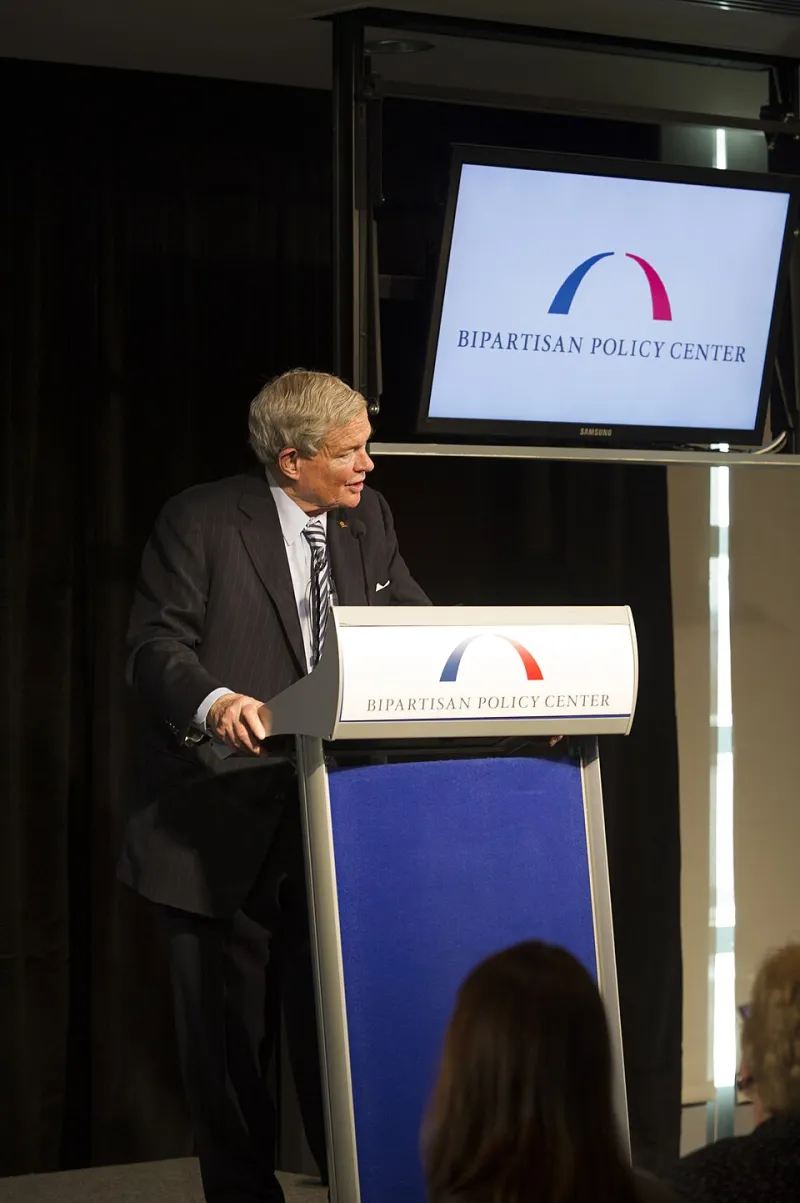
Photo: Department of Housing and Urban Development. Office of the Chief Human Capital Office. Office of Broadcasting Operations. Photo Section. (ca. 2011 - ca. 7/18/2014), Public domain, via Wikimedia Commons
WASHINGTON — In a city where bipartisan agreement is rarer than a congressional recess that ends on time, the American Center for Pragmatic Solutions has achieved something remarkable: it has united Republicans and Democrats, conservatives and liberals, supply-siders and deficit hawks, around a single, unshakeable conviction.
 Photo: American Center for Pragmatic Solutions, via cdn1.slideserve.com
Now is not the right time.
The Center, founded in 2019 with seed funding from a constellation of foundations whose boards overlap in ways that would take a determined graduate student several weeks to map, released its flagship annual report Wednesday under the title Toward Action: A Framework for Understanding Why the Current Moment Requires Further Preparation Before Action Can Responsibly Begin.
The 280-page document, described by its authors as "a pivotal contribution to the national conversation," concludes that the major challenges confronting the United States — healthcare costs, infrastructure decay, economic inequality, climate adaptation — are genuine, measurable, and addressable through known policy mechanisms. It then concludes, with equal conviction, that addressing them right now would be premature.
"We want to be absolutely clear," said the Center's co-executive director, former Republican Congressman Terrence Albright, at a morning press conference held in a room that cost more to rent per hour than most Americans earn in a week. "We are not saying do nothing. We are saying: not yet, not like this, and possibly not in this configuration."
 Photo: Terrence Albright, via cache.legacy.net
His co-director, former Democratic Senator Patricia Voss, nodded in vigorous agreement, which observers noted was the most vigorous agreement anyone had witnessed from either of them in their respective legislative careers.
The Methodology of Inaction
The American Center for Pragmatic Solutions prides itself on ideological diversity. Its board includes former officials from four administrations spanning three decades, two Nobel-adjacent economists whose actual Nobel status depends on how generously you define the word "adjacent," and a rotating cast of senior fellows whose biographies uniformly describe them as "thought leaders" without specifying which thoughts they are leading or where.
The Center's research process is, by its own account, exhaustive. Wednesday's report was the product of fourteen months of work, including six roundtables, three symposia, one "convening" (which differs from a symposium in ways the Center's communications team was unable to clarify), and a two-day retreat at a vineyard in Napa Valley that the Center describes as a "working session" and that the vineyard describes as a "private event."
 Photo: Napa Valley, via travelguide.winemag.com
"The depth of analysis here is genuinely unprecedented," said Dr. Miriam Cho, the Center's Director of Strategic Insight, who holds degrees from three institutions and has never held elected office, run a business, or, as far as public records indicate, filed a tax return in a state that experiences infrastructure problems. "We looked at every serious proposal on the table. We stress-tested them against current political realities. And what we found, consistently, was that the conditions for success simply aren't there yet."
She was asked what conditions would need to be present for success to become possible.
She said that was precisely what the Center's next report would address.
A Unity That Transcends Ideology
Perhaps the Center's most impressive achievement is the genuine warmth that has developed between its ideologically opposed co-directors. Albright, a former fiscal conservative who once described government spending as "a slow-acting poison," and Voss, who spent two Senate terms advocating for expanded federal programs, have found in each other a meeting of minds that their former colleagues describe as "surprising" and their former constituents describe as "something we'd like to ask them about."
Their unity is particularly striking given that they agree on almost nothing substantively. Albright believes the solution to healthcare costs lies in market competition. Voss believes it lies in federal intervention. Both believe, with equal fervor, that this is not the moment to try either.
"What Terrence and I have discovered," Voss told reporters, "is that our differences are actually a source of strength. Because when someone from my side of the aisle and someone from his side both agree that a proposal isn't ready, that's not gridlock. That's wisdom."
Albright said he couldn't have put it better himself, which is the most agreement he has expressed with a Democrat since a 2007 vote to rename a federal building.
The Timing Problem
The Center's reports have, over five years, identified a remarkably consistent obstacle to progress: timing. The 2020 report found that the political environment was too polarized for meaningful reform. The 2021 report found that the post-pandemic recovery period required stability over disruption. The 2022 report found that the midterm election cycle created unfavorable conditions for bold action. The 2023 report found that the post-midterm realignment period required careful navigation.
This year's report finds that the pre-election environment makes substantive policy movement inadvisable, and that stakeholders should focus instead on building the coalitional infrastructure that will enable action once conditions improve.
"The timing question is genuinely complex," said Dr. Cho. "People underestimate how complex it is. It's not simply a matter of waiting. It's about identifying the precise confluence of political, economic, and social factors that creates a genuine window for durable reform. And we're simply not there."
She was asked when the Center last identified a moment that did meet those conditions.
There was a pause long enough to be meaningful.
"That's a great question for the retrospective analysis we're planning for 2026," she said.
The Report About the Report
In a development that has drawn quiet admiration from Washington's professional observer class, the Center announced that its next major publication will examine the reception of Wednesday's report — specifically, why the report's 2022 predecessor, which recommended a series of preparatory steps toward eventual action, was itself received as premature by policymakers who felt the preparatory steps required their own preparation.
"There's a real intellectual puzzle there," said Albright. "If a recommendation to prepare for action is itself seen as requiring further preparation, what does that tell us about the underlying structural conditions? That's the question we want to answer."
He acknowledged, when pressed, that answering that question would likely produce a further set of recommendations.
He said he saw that as a feature.
What Experts Say
Experts not affiliated with the Center offered a range of assessments. Several political scientists noted that the Center's work represents a sophisticated and well-funded articulation of the Washington consensus that analysis is action, and that producing a report about a problem is meaningfully distinct from ignoring it, even if the practical outcomes are similar.
Others were more direct. "They've essentially industrialized the act of almost doing something," said one policy researcher who asked not to be named because he hopes to be a senior fellow somewhere one day. "It's impressive, honestly. As a business model."
The Center's annual budget is $14.3 million. Its offices feature floor-to-ceiling windows and a espresso machine that one visitor described as "almost aggressively nice."
A follow-up report is expected next spring. It will, sources confirmed, be worth reading carefully before any conclusions are drawn.