Intelligence Committee Publishes Landmark Transparency Report, Every Word of Which Is a Black Rectangle

WASHINGTON — The Senate Intelligence Committee unveiled its long-awaited report on improving government transparency Thursday morning, releasing to the American public a 47-page document consisting entirely of solid black rectangles, which officials described as "a bold step forward in the committee's ongoing commitment to openness."
The report, titled ████████████████: ████████ and ████ in the ████████ ████ (Working Title), took eighteen months to produce, cost an estimated $2.1 million in staff time and contractor fees, and contains, by the committee's own admission, "significant findings" that it "looks forward to sharing with the American people at such time as sharing with the American people does not constitute a federal crime."
"This is transparency in action," said Committee Chairman Gerald Foss (R-OH) at a press conference held in a room journalists were not permitted to enter. "The fact that this report exists — that we made it, that it has pages, that those pages have a thickness you can physically feel — all of that is public information. We are proud of that."
 Photo: Gerald Foss, via images.squarespace-cdn.com
The Most Open Secret in Washington
The report was commissioned in January of last year following bipartisan concern that federal agencies had become, in the words of an early resolution, "insufficiently transparent in ways that are difficult to specify without further investigation." The committee's mandate was to identify specific reforms that would make government information more accessible to ordinary Americans.
According to the committee's press release — itself partially redacted — the final report contains "actionable recommendations," "concrete proposals," and "at least one chart," the nature of which cannot be disclosed.
Ranking Member Diane Chu (D-CA) told reporters the document represented "exactly the kind of frank internal reckoning" that Americans had been demanding for years. When asked what the reckoning was about, she said she wasn't able to say. When asked whether she had personally read the unredacted version, she paused for what observers described as "a very specific kind of pause" and said the question was "a good one."
She did not answer it.
Why Transparency About Transparency Is Different
Committee staff were at pains Thursday to explain that the redactions were not, as critics suggested, ironic. They were, in fact, legally mandated.
"People hear 'transparency report, all blacked out' and they think there's some contradiction," said Deputy Communications Director Paul Enright, reading from notes. "There isn't. The report discusses methods by which the government could become more open. Those methods, if revealed, could be exploited by adversaries who would then know exactly how we planned to be more open, and could prepare accordingly."
A reporter from the Associated Press asked how a foreign adversary could exploit knowledge of, say, a proposal to publish more government data online.
Enright consulted his notes again. "I'm not able to get into specifics," he said. "But the threat is real."
Senator Foss later elaborated in a written statement that the redactions covered four categories of sensitive material: classified intelligence sources, classified intelligence methods, classified intelligence findings, and "a fourth category that is itself classified."
The Press Conference
The formal public rollout of the report took place at 2 p.m. in the Dirksen Senate Office Building, where Committee Spokeswoman Janet Merrill took the podium before approximately forty reporters and delivered a twelve-minute statement.
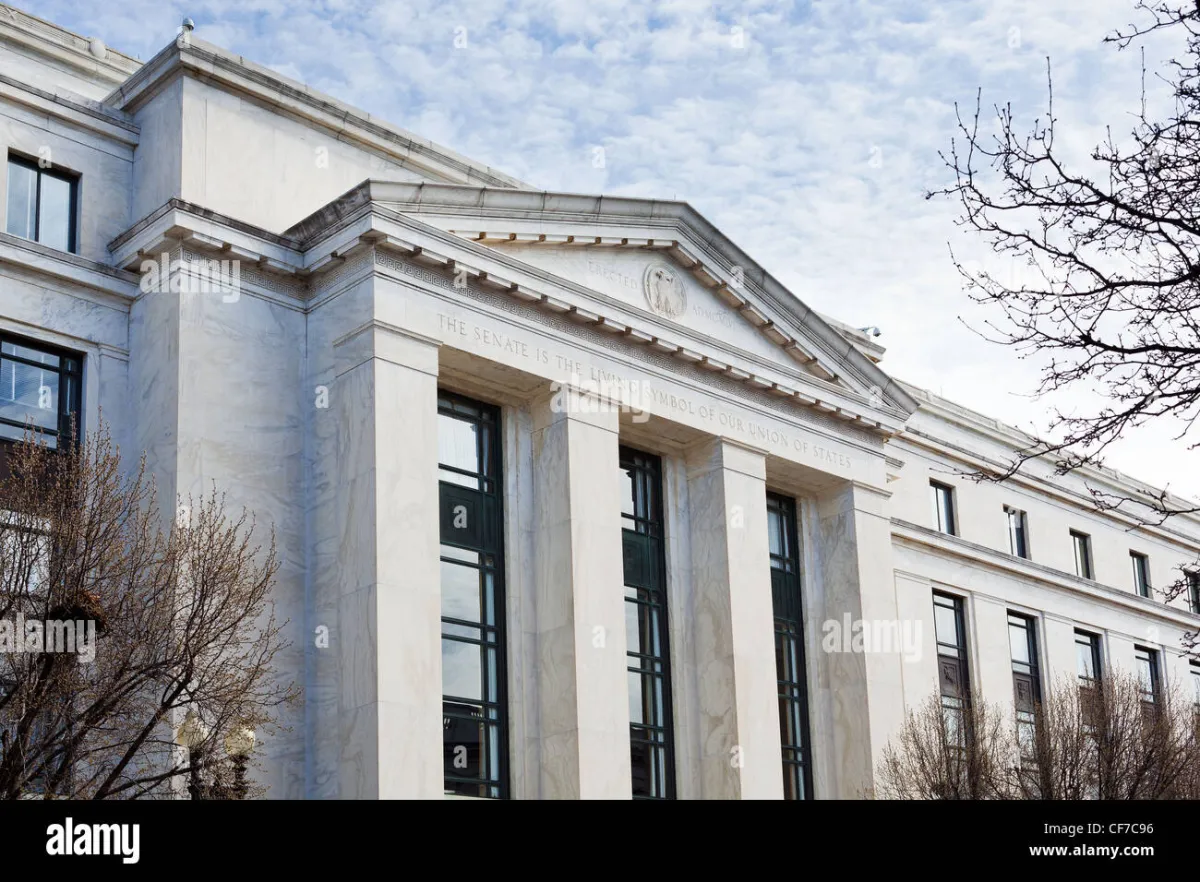 Photo: Dirksen Senate Office Building, via c8.alamy.com
Ms. Merrill read from a notecard.
The notecard was blacked out.
She read it with apparent fluency, pausing occasionally for emphasis, looking up twice to make eye contact with the front row, and concluding with what appeared to be a rhetorical flourish, her voice rising slightly before she said, "And that is why the committee remains committed to the principles of ████████ and ████████████ for all Americans."
She then invited questions, answered none of them on the grounds that the questions "touched on matters addressed in the report," thanked everyone for coming, and left through a side door.
A laminated copy of the report was available for viewing in a glass case in the lobby. Photographs were not permitted.
Expert Reaction
Government accountability scholars reacted to the release with what one described as "a very tired kind of disbelief."
"I've been studying congressional oversight for twenty-two years," said Dr. Patricia Lowe of the Brookings Institution. "I thought I had seen everything. I had not seen a transparency report that is legally prohibited from being read. That's new. I'll give them that."
The American Civil Liberties Union called the release "a masterclass in the appearance of accountability," noting that the committee had successfully generated a press conference, a press release, a formal report, a laminated display copy, and a bipartisan statement of pride — all without disclosing a single fact.
"In terms of the optics of openness," said ACLU senior counsel Marcus Webb, "they've absolutely nailed it. In terms of actual openness, they've produced a very expensive stack of black paper."
The committee disputed this characterization, noting that the paper was, in fact, white underneath.
What Happens Next
Committee staff confirmed that a declassified summary of the report is currently being prepared and is expected to be released within six to eighteen months, pending review by the Office of the Director of National Intelligence, the National Security Council, two federal courts, and "one additional body that we're not able to name at this time."
The declassified summary, staff noted, will itself be subject to redaction review.
When asked whether the summary of the transparency report might also be entirely blacked out, Enright said he was "optimistic" that some portions would be visible, though he was not able to confirm which portions, or whether those portions would include words.
The committee's next scheduled hearing on government transparency is closed to the public.
Tickets are not available.